 Catálogo de datos del IEO
Keyword
109
345 record(s)
Type of resources
Categories
Topics
INSPIRE themes
Keywords
Contact for the resource
Provided by
Years
Formats
Status
-
Overall objectives in the EU GO project are to assess the promising potential of seismic imaging for physical oceanography, in view of its combination of fine resolution and coverage unmatched by conventional oceanographic measurements. D318 was to provide the means of assessment by obtaining a unique, comprehensive, oceanographic and seismic dataset at the same time and place. Specific objectives for R.R.S. Discovery cruise 318a were to deploy four ADCP moorings, three adjacent temperature-logger moorings and STABLE, in an L-shape array in 750-1000m depth east of Portimao Canyon, carrying out adjacent CTD stations, deploy two OBH moorings, carry out seismic sections using the Ifremer high-frequency air-guns and streamer, accompanied by regular XBT and less frequent XCTD casts. In addition underway data was logged including ship-borne ADCP, surface temperature and salinity, meteorology, gravity and magnetics (to test new NERC magnetometers).
-
Overall objectives in the EU GO project are to assess the promising potential of seismic imaging for physical oceanography, in view of its combination of fine resolution and coverage unmatched by conventional oceanographic measurements. D318 was to provide the means of assessment by obtaining a unique comprehensive oceanographic and seismic dataset at the same time and place. Specific objectives for R.R.S. Discovery cruise 318b were to (i) recover four ADCP moorings, three adjacent temperature-logger moorings and STABLE, from 750-1000m depth east of Portimao Canyon (ii) perform deep water CTD casts (iii) carry out seismic sections using the NMF supplied Bolt airgun and streamer, accompanied by regular XBT and less frequent XCTD casts, iv) work with MV Poseidon to test novel seismic data acquistion strategies. In addition underway data was logged including ship-borne ADCP, surface temperature and salinity, meteorology, gravity and magnetics (to test new NERC magnetometers).
-
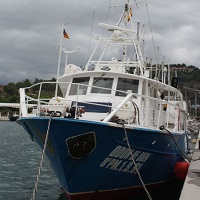
CR Ecomalaga 1002 Sampling oceanographic & biological variables to study the temporal variability. - ref 1002
-
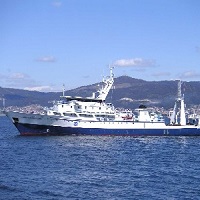
Acoustic survey, conducted with an annual periodicity, to assess and map the pelagic (neritic) resources and the oceanographic and biological conditions of the Gulf of Cadiz continental shelf (both Spanish and Portuguese waters, ICES Subdivision IXa South). The survey season coincides with the anchovy (Engraulis encrasicolus) peak spawning in order to estimate the anchovy SSB by echo-integration. The acoustic sampling for assessment by echo-integration is performed during daylight hours. Biological characterization of the pelagic community is sampled by opportunistic pelagic trawls (for identification of echo-traces), which are also performed during the day. Ancillary biological information (fish eggs) sampled with CUFES (Continuous Underway Fish Egg Sampler) and coupled to the acoustic sampling. Occurrence of sea birds, turtles, and mammals is also recorded along the acoustic transects. Oceanographic characterization of the surveyed area from both discrete (CTD profiles in night stations) and continuous sampling (Thermosalinometer-fluorimeter) coupled to the CUFES sampling. Additional night pelagic trawls were also performed in order to collate some extra biological material and to carry out specific experiments (e.g., in situ determination of the anchovy target strength, TS; nictimeral behavior?).
-
1.- Estimacion de los indices de abundancia (numero y biomasa), de las especies demersales de mayor interes pesquero, asi como de la fauna asociada a ellas. 2.- Determinacion de la distribucion geografica y batimetrica de las diferentes especies. 3.- Obtencion de las distribuciones de tallas de peces, de las capturas asi como de los crustaceos y moluscos de interes pesquero. 4.- Extraccion de otolitos de merluza. 5.- Obtención de datos biologicos de las principales especies comerciales: estados de madurez, proporción de sexos 6.- Obtencion de datos oceanograficos.
-
1.- Estimacion de los indices de abundancia (numero y biomasa), de las especies demersales de mayor interes pesquero, asi como de la fauna asociada a ellas. 2.- Determinacion de la distribucion geografica y batimetrica de las diferentes especies. 3.- Obtencion de las distribuciones de tallas de peces, de las capturas asi como de los crustaceos y moluscos de interes pesquero. 4.- Extraccion de otolitos de merluza. 5.- Obtencion de datos biologicos de las principales especies comerciales: estados de madurez, proporcion de sexos 6.- Obtencion de datos oceanograficos.
-
To estimate the abundance indexes (number and bimass) of demersal species.\nTo determine the geographic and bathimetric distribution of the different species.\nTo get the size frequency distributions of the catches of all fishes, as well as the crustaceans and molluscs of commercial interest.\nTo get biological data of the main commercial especies.\nTo get selectivity parameters\nTo elaborate a faunistic catalogue
-
Cr. 198200154 ALSAREV-0582 Ref. X2945756.982 ICES created form
-
1.- Estimación de los indices de abundancia (numero y biomasa), de las especies demersales de mayor interes pesquero, así como de la fauna asociada a ellas. 2.- Determinación de la distribución geografica y batimétrica de las diferentes especies. 3.- Obtención de las distribuciones de tallas de peces, de las capturas as?? como de los crustáceos y moluscos de interes pesquero. 4.- Extracción de otolitos de merluza. 5.- Obtención de datos biológicos de las principales especies comerciales: estados de madurez, proporción de sexos 6.- Obtención de datos oceanograficos.
-
1.- Estimacion de los indices de abundancia (numero y biomasa), de las especies demersales de mayor interes pesquero, asi como de la fauna asociada a ellas. 2.- Determinacion de la distribucion geografica y batimetrica de las diferentes especies. 3.- Obtencion de las distribuciones de tallas de peces, de las capturas asi como de los crustaceos y moluscos de interes pesquero. 4.- Extraccion de otolitos de merluza. 5.- Obtencion de datos biologicos de las principales especies comerciales: estados de madurez, proporcion de sexos 6.- Obtención de datos oceanograficos.