 Catálogo de datos del IEO
Creation year
2012
225 record(s)
Type of resources
Categories
Topics
INSPIRE themes
Keywords
Contact for the resource
Provided by
Years
Formats
Status
-
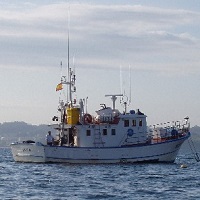
Monthly survey to study thermohaline and biological characterization of water masses in the East-North Atlantic.
-
Monthly survey to study thermohaline and biological characterization of water masses in the East-North Atlantic.
-
Monthly survey to study thermohaline and biological characterization of water masses in the East-North Atlantic.
-
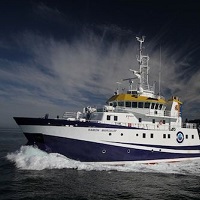
Swath bathymetry and seismic studies using the following echosounders: EM710, TOPAS, EK60, EA600 and seismic Sparker. Also gravity cores and box core were used.
-
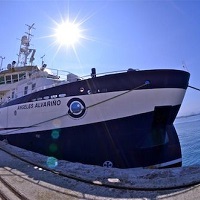
This survey has been projected in the frame of La Restinga Volcano monitoring. After a wide number of surveys conducted by R/V Ramon Margalef during the volcano crissis (from october 2011 to february 2012) the aim this time is to compleate a bathymetric surver again in order to find out possible changes in geomorphology, Sound velocity profiles will be carried out in order to obtain the best accuracy on the data adquired.
-
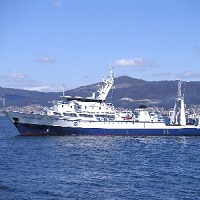
Evaluation of demersal and benthic ecosystem in the northern coast of Spain, using bottom trawl surveys
-

The sediments of the Galician Interior Basin realm are capable of recording the peculiar conditions of the last glacial‐interglacial dynamics transition into the current interglacial and their evolution into present day, as they are influenced by the Thermohaline Circulation (THC) and because their proximity to the important continental land‐mass of western Iberia. The knowledge of the rates and magnitudes of change of this system is critical to understand its climate dynamics, processes and feedbacks, and hence its role on a local to sub‐regional scale. The inference of these climatic mechanisms encrypted in the deep‐sea sedimentary record needs to constrain the spatial and temporal scales of the sedimentary processes involved, in particular the identification of source areas, pathways and transport, storage times and hydrodynamic conditions. To adequately assess these encrypted sedimentary archives it is instrumental to identify the sedimentary expression of the main processes and forcements involved and accurately determine the spatial and temporal scales, rates and magnitudes of the processes and feedbacks that generate these records. This proposal aims to carry out a high‐resolution reconstruction of the transport time,provenance, sediment fluxes, wave climate, bottom‐current variability and post‐depositional alteration in a number of surficial samples and cores from the Galician Interior Basin. This project will provide a first insight into the relation between the last North Atlantic climate oscillation and the local regional components including abrupt climate changes (i.e. H events) and local events since the end of the last glacial period from a paleoclimatic proxies perspective. We will use a twofold approach by first constraining the current sedimentary conditions to their associated local wave climate and North Atlantic regional forcements to subsequently infer the paleoenvironmental conditions from the past 30‐50 ky sedimentary record. Firstly, analysing and modelling the present hydraulic conditions from newly acquired and historical wave climate and oceanographic records from the study area will study the current sedimentary conditions and forcements. These data will be linked to the present day sedimentation conditions by direct measurements of present day sedimentation and oceanographic conditions, supported by moored sediment traps, CTD, Doppler records and surficial samples. Epifauna, infauna, microfauna and sediment microestructure will also be studied. Subsequently we will udertake a multidisciplinary study combining high‐resolution geochemical, physical properties, environmental magnetic sediment derived records with high precision U‐series isotopes analyses in a well‐constrained geochronological framework. Further support will be provided by seismic‐acoustic data acquisition. The combination of these sedimentological, micropaleontological, geochemical and geophysical tools will help in better resolving the role of current strength, circulation and sediment provenance changes also considering across vs. along margin transport balances in the sedimentary record of the Galician Internal basin over the last 30‐50 ky
-
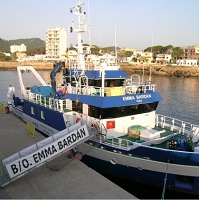
Evaluate the conservation status of the lobster population (Palinurus elephas) and determine the Reserve Effect. To do this, the demographic structure, abundance and bathymetric distribution of juveniles and recruits are estimated, videos and visual censuses are made to estimate the effect of the reserve expansion, and specimens of cephalothorax (<15mm) are obtained for genetic studies. of populations and isotopic composition
-
Conducting systematic sampling contemplated within the research project IEO oceanographic time series data in the Gulf of Cadiz.
-
Annual estimation of the abundance of anchovy juveniles (Engraulis encrasicolus) through acoustic methodology, and study of spatial distribution and growth status during that specific time of the year. With the results obtained, this campaign aims to estimate an annual abundance index of juveniles that allows to infer each year the magnitude of the annual recruitment of anchovy that will enter the population the following year