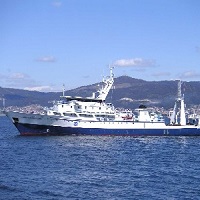
IEO 0574
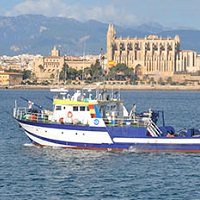
IEO 0474
Cr. Tunidos & Canarias MARCAL 9207 - ref CEDO 9201
Cr. CANARIAS 9310. - ref CEDO 9407
Marcado de bacalao en la division 3M de NAFO, recogida de muestras y datos biologicos de bacalao y de especies acompanantes, recogida de datos de salinidad y temperatura
Forty-jour CTD stations were conducted out during the cruise Canarias 9205 qf the R. Ii Francisco de Paula Navarro. The present publication is based on the study of the geostrojic circulation and data on temperature, salinity and density obtained j?om these stations, from the sea surface to a depth of 500 m. Zn the western urea of the region, where the stations are closer togeths the geostrophic circulation shows a cyclonic eddy in the Tenertfe-Gomera channel and another antiqcl nic to the South of these islands. The temperature and salinity distributions also show both eddies. In the middle of the qclonic eddy, the upwelled water comes from a depth of about 75 m. On the another hand, the temperature and salinity distributions show, between Gran Canaria and Fuerteventura Glands, the end of ajilament ofupwelled water on the nearby Aftican coast, that had a thick of about 50 m ofj Punta Janda.
Cr. Campana Experimental Canarias 9206 - ref CEDO 9111
It was conducted by the ICCM with the main objective to collect observations in the Canary Islands marine environment; to the north by making the monthly visit to the ESTOC site, and to the south to study the dinamicity in the water column due to the arrival of different water masses and the African coastal upwelling.\n1. To comply with the monthly sampling at the ESTOC station 812. Data was taken to 3700 m at 24 depths from surface to bottom making two profiles, since there was only available a rosette with 12 bottles of 10 l. Samples for oxygen, carbon system, nutrients, gelbstoff, salinity and chlorophyll 'a' (the later to 200m) were taken.\n2. Deploy of two drifting buoys from NOAA (National Oceanographic and Atmospheric Administration, USA) at stations 812 (ESTOC) and 824 (eddy), as part of the collaboration between the ICCM and NOAA to study the surface currents in the Canary Islands environment.\n3. Carry out hydrographic investigations in the triangle area enclosed by the south of the Canary Islands. A total of 23 CTD/rosette stations were made, casting two profiles per station (2000-200m, 200-5m); it provided enough data to characterize the water column. Samples for oxygen, the carbon system, nutrients, gelbstoff, salinity and chlorophyll 'a' (the later to 200m) were taken.\n4. Deploy of 3 ARGOS floats at stations 818, 835 and 843 .\n5. Drop 8 expandable bathythermograph to thermally characterise the extent of the eddy supposed to be located at station 824.
Sahara 1/1971. All measurements were made underway
This equipment trials cruise has provided opportunities for test and verification of technology under development at the Proudman Oceanographic Laboratory (POL), the Scottish Association for Marine Science (SAMS) and the National Oceanography Centre, Southampton (NOC,S). This includes equipment developed during the first year of funding under OCEANS 2025 (theme 8). Testing technology in the ocean environment is invaluable in assessing fitness for purpose. Specifically, the cruise tested: A Spar wave buoy (NOC,S) biogeochemical sensors (NOC,S); an UAV system (NOC,S); a video grab system "HyBis" (NOC,S), A benthic Multicore (NOC,S), A benthic lander and associated torroidal Telemetry buoy (POL), and a shallow tow towfish (POL). Testing in Spanish waters (near Tenerife, Gran Canaria and Fuerteventura) has been invaluable. The time on passage has been minimised (the transition from deep to shallow water is less than a days steaming) and the calm conditions to the southwest of the islands in the consistent prevailing north easterly winds have enabled deployment and recovery techniques to be tried and optimised in safety.