 Catálogo de datos del IEO
Keyword
meteorological packages
159 record(s)
Type of resources
Categories
Topics
INSPIRE themes
Keywords
Contact for the resource
Provided by
Years
Formats
Status
-
Acoustic measurements.
-
Retrieving an array of moored current meters recording subtidal circulation on the ocean margins of the Bay of Biscay (Armorican and Aquitaine shelves and slopes). Related hydrological measurements taken. This falls under the ASPEX project.
-
Small pelagic fish are both the keystone species of the ecosystem because of the central position they hold in the food chain and represent highly significant economic stakes for fisheries since they make up the majority of landings in the French Mediterranean (approximately 50% of catches for sardines and anchovies; Demaneche et al. 2009). So, to assess stocks and propose appropriate management methods, it is important to have both good knowledge about these species and independent fisheries data. Ifremer's fisheries science laboratory in Sète has monitored these populations since the 1990s. In 2002, the EU asked Member States to formalize certain operations by contract, in this context, the PELMED cruise was part of the extended contractual programme for biomass assessment (DCF). Therefore, each year France is obliged to assess the biomass of small pelagic species in the Mediterranean, in order to determine the stocks' status and propose management measures. These assessments are carried out in the framework of the general fisheries commission for the Mediterranean (CGPM). Since numerous countries had begun monitoring these species using acoustic methods, the MEDIAS (MEDIterannean Acoustic Surveys) scientific group was created in 2008 with the objective of standardizing the protocols. Finally, national management plans for Gulf of Lion fisheries were set up in 2014 (particularly for pelagic trawlers and purse seines) with scientific objectives touching on the biomass of small pelagics. The PELMED cruise, whose main aim is to directly assess the small pelagics biomass, is conducted therefore in a clearly institutional framework (national, European and Mediterranean). However, the scientific stakes remain just as important. Since 2008, a special situation has been observed in the Gulf of Lion, where the biomasses of sardines and anchovies (and even mackerel) have decreased synchronously. Even more unexpectedly, although the recruitment rates observed over the past few years in the species are particularly high, the populations don't seem to be growing back and their biomass is continuing to drop. This is particularly surprising in a marine ecosystem where recruitment is generally considered to be the determining factor of population dynamics for species with a short life span. The collection of biological parameters on species of small pelagics done during the previous PELMED cruises made it possible to highlight significant demographic changes (loss of large age classes, decrease in size, poorer body condition) which seem to suggest "bottom-up" population control. Therefore, the ecosystem-based nature of the PELMED cruises (from physical parameters to top predators, not to mention phyto- and zooplankton and fodder fish) appears to be crucial in understanding the dynamics of these populations. It was decided this year to stop prospecting the Catalan Sea, in order to extend the spatial coverage to the east of the Gulf in the PACA region (from Marseille to Nice). Since the narrowness of the shelf in this zone does not allow for prospecting along "classic" legs, the objective will be to validate a prospection method which is adapted to the area.
-
The main objective of the MOOSE-GE cruises is to observe the annual evolution of the Northwestern Mediterranean Sea in the context of the climate change and anthropogenic pressure in order to be able to detect and identify long-term environmental trend and anomalies of the marine ecosystem. The annual cruise focuses on moorings maintenance and hydrology, biogeochemistry and biology monitoring of the Northwestern Mediterranean basin. It aims to follow variability of water masses properties (LIW and WMDW) and biogeochemical and biological content related to these water masses. BILLION 36 cruise was part of this cruise too.
-
NA
-
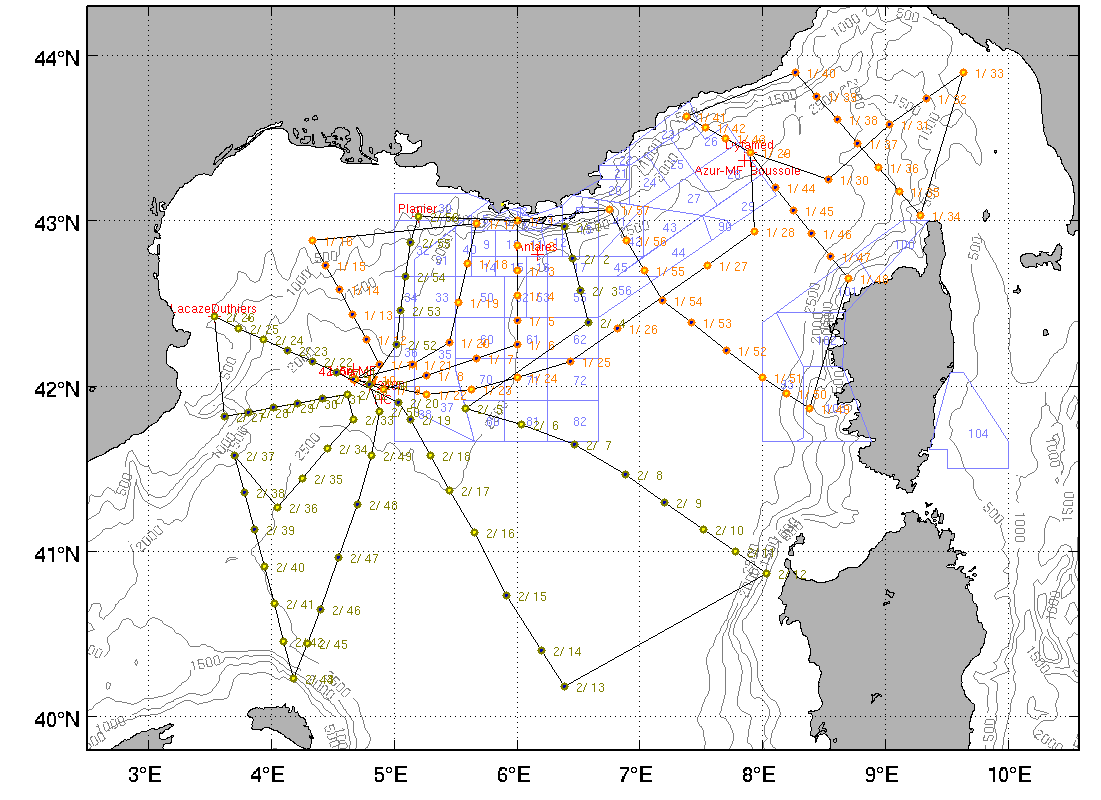
The main objective of the MOOSE-GE cruises is to observe the annual evolution of the Northwestern Mediterranean Sea in the context of the climate change and anthropogenic pressure in order to be able to detect and identify long-term environmental trend and anomalies of the marine ecosystem. The annual cruise focuses on moorings maintenance and hydrology, biogeochemistry and biology monitoring of the Northwestern Mediterranean basin. It aims to follow variability of water masses properties (LIW and WMDW) and biogeochemical and biological content related to these water masses. BILLION 32 cruise was part of this cruise too.
-
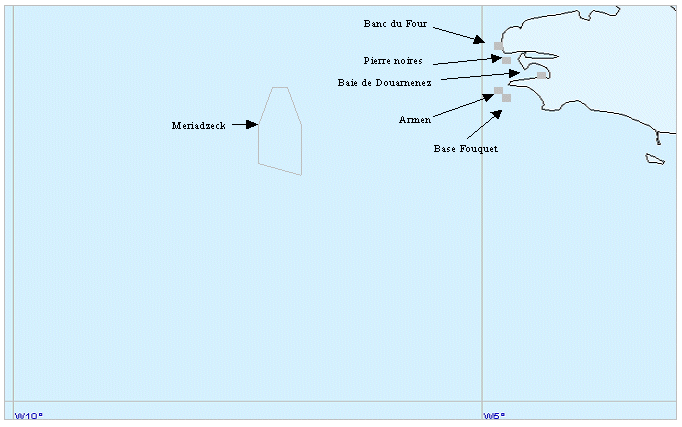
<p>Technical trials for NAUTILE, SYSIF, SMF RESON, GAPS and MATS equipment. The trials cruise had 2 legs: Leg 1 from 04/05/09 to 15/05/09 (Brest - La Coruna) and Leg 2 from 16/05/09 to 19/05/09 (La Coruna - Funchal).</p>
-
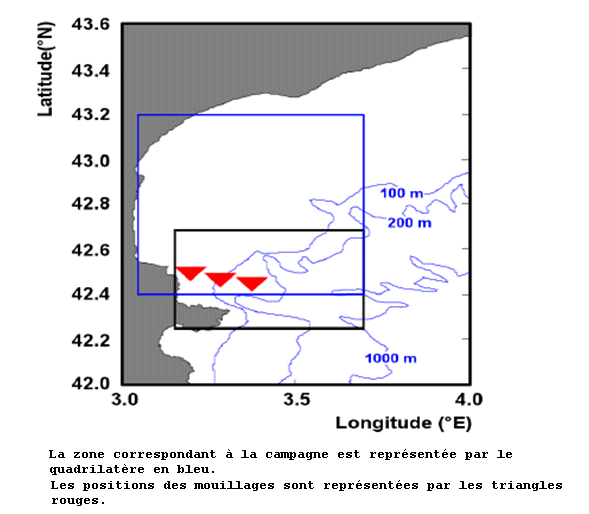
<p>Studying eddies related to water circulation in the Gulf of Lion. The LOPB and LOMIC labs will implement a technique never used before for coastal systems, i.e. tracking of a water mass using the chemically inert compound sulphur hexafluoride (SF6). After injecting the tracer from aboard RV Suroît, the substance's dissemination will be estimated thanks to real-time measurements performed on board. To monitor the eddy structure, RV Suroît will be accompanied by RV Tethys II. Several innovative devices or systems will be deployed simultaneously (measuring currents using Doppler acoustic profiler (with the moorings already in the zone since 2009 and the 2 vessels' shipboard current meters); Measuring surface currents using an array of HF radars installed onshore; several satellite-monitored drifting buoys, including a CARIOCA buoy which will continuously log the physical parameters and CO2 trends near the surface; autonomous underwater gliders fitted with various biogeochemical sensors; real-time satellite observation of surface temperature and phytoplankton concentrations; and operational numerical modelling. The measurements will be analyzed on board and will be used to locate the eddy's position in order to guide the vessels to the drifting research zone. The original aspect of LATEX is that it combines expertise in physical oceanography and marine biogeochemistry to try and penetrate the mystery of these mesoscale structures and particularly to assess the role they play in transfer of matter between the coastal zone and the open sea. The fate of organic matter will be closely observed during this monitoring of the drifting eddy structure to understand how the biogeochemical properties (quality of organic matter, stoichiometry of particulate matter, primary and bacterial production) evolve over time in this volume of water enclosed by physical processes.</p>
-
The main objective of the MOOSE-GE cruises is to observe the annual evolution of the Northwestern Mediterranean Sea in the context of the climate change and anthropogenic pressure in order to be able to detect and identify long-term environmental trend and anomalies of the marine ecosystem. The annual cruise focuses on moorings maintenance and hydrology, biogeochemistry and biology monitoring of the Northwestern Mediterranean basin. It aims to follow variability of water masses properties (LIW and WMDW) and biogeochemical and biological content related to these water masses.
-
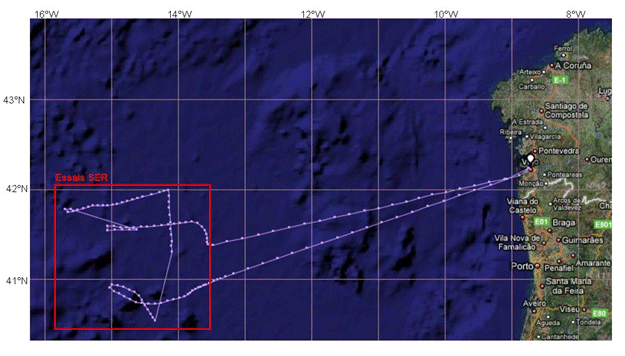
Technological trials run on seismic equipment developed by the SERCEL firm.