 Catálogo de Datos del IEO
Keyword
discrete water samplers
319 record(s)
Type of resources
Categories
Topics
INSPIRE themes
Keywords
Contact for the resource
Provided by
Years
Formats
Status
-
IEO 0470
-
IEO 0672
-
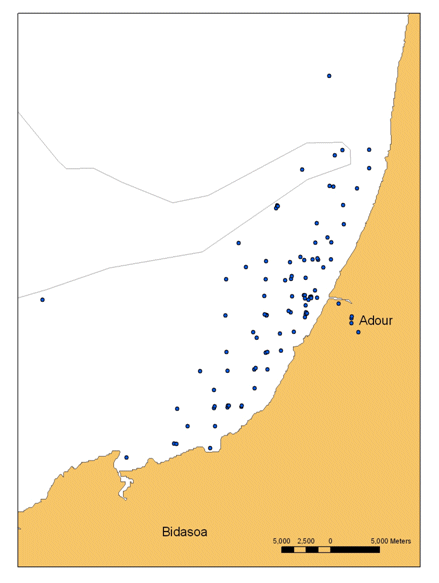
The BATEL-1 cruise was conducted from 4 to 14 June 2007 by the University of Bordeaux-1 (EPOC laboratory). The main objective was to obtain a database of optical and geochemical data in order to create algorithms to quantify the suspended particles and dissolved substances for the interpretation of MODIS, SPOT, ASTER and FORMOSAT-2 satellite images. The end purpose is to identify coastal water composition from satellite images. The second aim was to monitor the Adour river's turbidity plume during this period. In addition, measurements were taken to analyze the heavy metals, stratification of water masses (CTD) and for intercomparison of two fluorimeters. These measurements are currently being used by Ms. Petus (Thesis, Cifre grant). The cruise fell under the interregional Aquitaine-Euskadi programme.
-
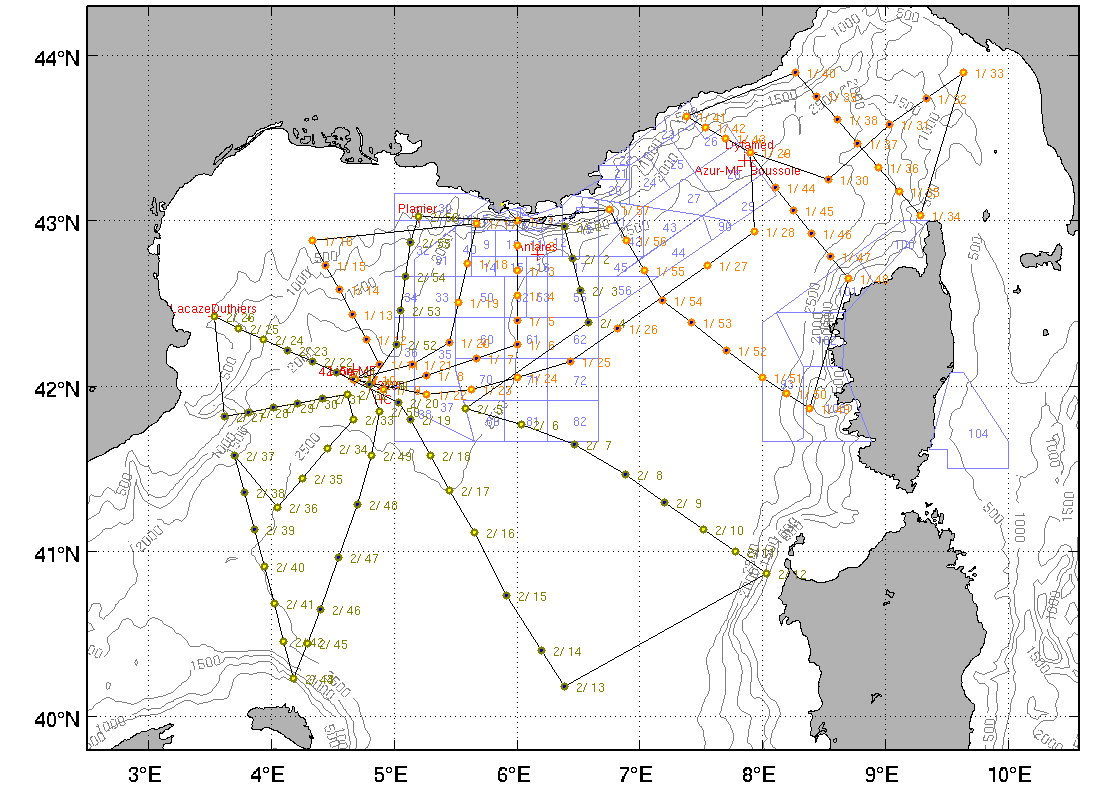
The main objective of the MOOSE-GE cruises is to observe the annual evolution of the Northwestern Mediterranean Sea in the context of the climate change and anthropogenic pressure in order to be able to detect and identify long-term environmental trend and anomalies of the marine ecosystem. The annual cruise focuses on moorings maintenance and hydrology, biogeochemistry and biology monitoring of the Northwestern Mediterranean basin. It aims to follow variability of water masses properties (LIW and WMDW) and biogeochemical and biological content related to these water masses. BILLION 32 cruise was part of this cruise too.
-
Optical (Rrs) and hydrological measurements to determine and quantify particles in suspension and dissolved organic matter at the surface of the water using satellite images. The measurements taken along the Basque country coast are used to validate the algorithms developed using data from the BATEL-1 mission. An additional objective is to supply in-situ optical and hydrological data for the doctoral theses of C. Petus and S.Novoa. The oceanographic mission took place in 2 parts due to a mechanical incident aboard RV Côte de la Manche. The cruise is part of the inter-regional Aquitaine-Euskadi (OOSSEA) programme, CIFRE contract.
-
The series of PELMED cruises began in 1993. Their objective is to assess small pelagic resources in the Gulf of Lion, using the echo-integration method and trawling to identify the detections observed. Until 2007, each cruise consisted in systematically prospecting from Port-Vendres to Marseille, along 9 legs set 12 nautical miles apart, perpendicular to the coast, in daytime (6 am to 9 pm), along the entire width of the continental shelf. Acquisition along legs for acoustic prospection covered 440 nautical miles and the catches from trawling to identify the structures encountered led to a complete analysis: number and weight by species, size sampling, otolith samples taken in order to construct size-age keys for sardines, anchovies and hake, updating of biological parameters.
-

IEO 0467
-
IEO 0866
-
IEO 0168
-

monitoring the temperature and salinity along the water column (500m). 116 casts. sections 43N, 6W and 8W