 Catálogo de datos del IEO
Keyword
Lagrangian currents and transport rates in the water column
14 record(s)
Type of resources
Categories
Topics
INSPIRE themes
Keywords
Contact for the resource
Provided by
Years
Formats
Status
-
Campaign GENESIS 2 "Pen Duick/Melilla", the second of three ROV campaigns, will focus on "Pen Duick Escarpment" in the Gulf of Cadiz or on the recently discovered "Melilla mounds" in the South-East Alboran Sea (Mediterranean Sea). The final choice of the study area will depend on the results of the TTR17 cruise with R/V Logachev (June-July 2008) and the R/V Marion Dufresne cruise (June 2008). One of these study areas will be surveyed using multibeam, side-scan sonar and high resolution seismics. Based on this site survey, the ROV Genesis will be deployed to carry out detailed mapping. Also the hydrography and sediment dynamics of the area will be studied with respect to the steering of the present ecosystems. GENESIS 2 takes place in the framework of the European projects HERMES (EC FP6), MiCROSYSTEMS (ESF) and HERMIONE (EC FP7).
-
The area in between the Audierne and St. Nazaire canyons (Gascogne) along the Armorican margin was one of the areas where the "massifs coralliens" were described for the very first time. Within the framework of the HERMES (EC FP6), MiCROSYSTEMS (ESF) and GeNeSis (FWO) projects, this area will be surveyed using multibeam and high resolution seismics during LEG 1. Based on this site survey, the ROV Genesis will be deployed to carry out detailed mapping of these deep-water "hot-spots". Also the hydrography and sediment dynamics of this area will be studied with respect to the steering of the present ecosystems. LEG 2 will focus on the Galicia bank. This location has been assigned as reference area within the ESF project BIOFUN. In addition to a bathymetric and seismic surveying, also biological sampling and experiments are planned here.The BELCOLOUR-2 project aims at improving the quality of existing optical remote sensing products for marine, coastal and inland waters based on new scientific knowledge and to develop new products (including partial pressure of CO2 and primary production) for key applications such as aquaculture and air-sea CO2 flux quantification. This project takes place in the frame of the research program for earth observation 'STEREO' of the Federal Science Policy.
-
The objectives of the BELMER project are: - to validate the MERIS water products for Belgian coastal waters and neighbouring French, UK and Dutch waters - to provide a quantitative statement of product accuracy and recommendations for improvements in the scientific algorithms, where appropriate. In particular the problems reported by the MERIS validation and user communities of turbid water atmospheric correction, case 2 water chlorophyll retrieval, adjacency effects (straylight), moderate sunglint, spatio-temporal variability of specific inherent optical properties and bottom reflectance will be addressed. This project is funded by the "PROgramme for the Development of scientific Experiments" (PRODEX) of the European Space Agency (ESA).
-
The SCANS-II project aims at estimating the abundance of small cetaceans inhabiting shelf waters of the Atlantic margin, the North Sea and adjacent waters. Different methods will be used; ship-based monitoring is one of these. Data on abundance are essential to assess the impact of bycatch and other threats, and as input to management actions to ensure the favourable conservation status of these species. The project will develop a management framework to use such data. This will be centred on relatively simple but spatially explicit dynamic models tested by simulation to ensure robustness. An essential part of this long-term management is a robust cost-effective means of monitoring abundance between major SCANS-type surveys; the project will develop and test potential methods, and recommend a suite of monitoring protocols.The "BEL-COLOUR" aims at improving the theoretical basis and software tools for applications of suspended matter and chlorophyll-based satellite data products in coastal waters. In addition to algorithm work and image processing BEL-COLOUR will participate in sea borne cruises for the purposes of calibration of algorithms and for validation of the end products. The project "BEL-COLOUR", funded by the <a href="http://www.belspo.be">Federal Science Policy</a>, within the programme for Earth Observation "STEREO" - Study and management of Coastal Regions.
-
The objectives of the BELMER project are: - to validate the MERIS water products for Belgian coastal waters and neighbouring French, UK and Dutch waters - to provide a quantitative statement of product accuracy and recommendations for improvements in the scientific algorithms, where appropriate. In particular the problems reported by the MERIS validation and user communities of turbid water atmospheric correction, case 2 water chlorophyll retrieval, adjacency effects (straylight), moderate sunglint, spatio-temporal variability of specific inherent optical properties and bottom reflectance will be addressed. This project is funded by the "PROgramme for the Development of scientific Experiments" (PRODEX) of the European Space Agency (ESA).
-
The area in between the Audierne and St. Nazaire canyons (Gascogne) along the Armorican margin was one of the areas where the "massifs coralliens" were described for the very first time. Within the framework of the HERMES (EC FP6), MiCROSYSTEMS (ESF) and GeNeSis (FWO) projects, this area will be surveyed using multibeam and high resolution seismics during LEG 1. Based on this site survey, the ROV Genesis will be deployed to carry out detailed mapping of these deep-water "hot-spots". Also the hydrography and sediment dynamics of this area will be studied with respect to the steering of the present ecosystems. LEG 2 will focus on the Galicia bank. This location has been assigned as reference area within the ESF project BIOFUN. In addition to a bathymetric and seismic surveying, also biological sampling and experiments are planned here.
-
Our project aims at assessing the different biogeochemical processes controlling the nitrogen cycle in oligotrophic N.E. Atlantic waters. Our approach is based on the use of dual nitrate isotope measurements (natural abundance and enrichment experiments) to disentangle these various N processes in the marine environment, and in particular the process of diazotrophy by which atmospheric N2 is introduced into the oceanic fixed nitrogen reservoir. This input of "new" nitrogen should stand in balance with the denitrification process by which N is lost from the oceanic system. There are indications that the intensity as well as the geographical distribution of diazotrophic activity has been underestimated till date. Our observations, made the past few years, indicate that diazotrophic activity is present in the Azores Current region (DIAPICNA, EUROFLEET cruise; July 2011) and along a meridional section through the Atlantic Ocean (EUROPA cruise; European Universities & Research On board RV Polarstern in the Atlantic, Nov. 2012). During the EUROPA cruise maximal fixation rates were observed around 20°N, south of the Canary Islands, but diazotrophic activity was detected at all latitudes, even at 38°N , the northernmost station sampled during the EUROPA cruise. It is of interest to better document diazotrophic activity at latitudes of 38°N and northward. We propose to study the different biogeochemical processes acting on the marine N-cycle, including N2 fixation, along a N-S section through the Gulf of Biscay to Cape Finistere and further south in open ocean waters along the Iberian peninsula till about 36°30'N. On board we will measure primary production, N-nutrient uptake and N2 fixation in the euphotic layer, using 13C, 15N enriched incubation experiments. We also will sample the upper 1000m of water column for nutrient concentration and N-nutrient natural isotopic composition analyses. This investigation will be coupled with a newly started PhD project, financed by FNRS (Aspirant mandate) and in co-tutelle between ULB and VUB, aiming at studying the impact of the marine iron biogeochemistry on the phytoplankton and the diazotroph communities. During the campaign, we shall perform incubation experiments using in-situ oligotrophic surface waters to examine the influence of the addition of dissolved iron and that of natural desert dusts on the phytoplanktonic production and diazotrophic activity.The AUMS project is inspired by the success of similar systems deployed on various ships of opportunity in the framework of the European Union FerryBox project (www.ferrybox.org). The instrumentation will greatly enhance the continuous oceanographic measurements made by RV Belgica by taking advantage of the significant technological improvements since the design of the existing (salinity, temperature, fluorescence) systems. In particular, many new parameters can now be measured continuously including important ecosystem parameters such as nitrate, ammonia, silicate, dissolved oxygen and CO2, turbidity, alkalinity and phytoplankton pigments. In addition, the new equipment allows automatic acquisition and preservation of water samples, rendering RV Belgica operations significantly more efficient by reducing onboard human resources. Data will be available in near real-time via the public website of OD NATURE and following quality control, from the Belgian Marine Data Centre.Collection of GNSS data in the maritime environment for performance evaluation under different conditions.Aim of the project is to cultivate marine bacteria able to degrade hydrocarbons at both atmospheric and high pressure, in aerobic and anaerobic environments. Kill-Spill is an European funded FP7 project focusing on the development of highly efficient, economically and environmentally viable solutions for the clean-up of oil spills caused by maritime transport or offshore oil exploration and related processes. It provides new tools to promote novel (bio)technologies in oi
-
The objective of this project is the investigation of the structure and functioning of different CWC successional habitats (living, dead and buried corals), in order to understand the response of the CWC to a changing ocean. Therefore, we identified 4 specific objectives which will allow us to get insight in the distribution of these CWC habitats (objective 1), the responsible environmental drivers (objective 2), the associated (molecular and morphological) biodiversity (objective 3) and the connectivity between distinct CWC habitats at different spatial scales (objective 4). We will concentrate our study on the Bay of Biscay by providing multiple-scale analysis of habitat mapping, environmental characterisation, biodiversity patterns and processes of interconnectivity. However, comparisons will be made through European-US collaboration with other regions at both sides of the Atlantic in order to understand amphi- and trans-Atlantic distribution patterns and processes. This project is part of the 7th EC Framework Programme Hermione (Hotspot Ecosystem Research and Man's Impact On European Seas) (2011-2013).This monitoring project aims to execute a continuous research on the effects of the exploitation of non-living resources of the territorial sea and the continental shelf on the sedimentary movements and the marine environment (Law of 13 June 1969 on the exploration and exploitation of non-living resources of the territorial sea and the continental shelf). Belgian national research program.
-
The GENESIS 1 "Ortegal" cruise will focus, as first one in a series of 3 ROV cruises, on the "Massif Galicien de l'Ouest", located near the "Cabo Ortegal" in the southern part of the Bay of Biscay. These suspected deep-water coral hotspots, earlier described by Le Danois in 1948, will be surveyed using multibeam bathymetry and high resolution seismic profiling. Based on this site survey, ROV Genesis will focus on the detailed visual mapping and sampling of selected sites. Also the hydrography and sediment dynamics of the study area will be studied with respect to their role in steering the present ecosystems. As preparation for the GENESIS 3 cruise, the ROV will also deploy a biological experiment. GENESIS 1 takes place within the framework of the European projects HERMES (EC FP6), MiCROSYSTEMS (ESF) and HERMIONE (EC FP7).
-
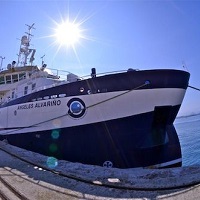
The goals of this campaign are framed within the objectives of the overall project, being the experimental cruise of the proposal. Thus, this cruise will help to: - Characterize the different modes of variability of heat and mass transport in easternorth atlantic subtropical gyre. - Determine the structure of the current when it reaches the Canary Islands, mass transport, heat and nutrients and interannual variability. - To determine the correlation between heat and mass transport with the NAO atmospheric and oceanic index. - Characterize the annual cycle in the physical conditions of the surface layers and mixture to where the seasonal cycle is significant, relating it to the meteorological forcings. - Characterization of changes in water masses, mainly in the North Atlantic Central Water (NACW), in Antarctic Atlantic Intermediate Water (AAIW) in Mediterranean Water (MW) and bottom waters of the Canary Basin, in based on temperature, salinity, nutrients and oxygen. - Quantify CO2 transport through atmosphere-ocean of latitude 29 ° N. - Continue with the steps taken for over a year south of La Restinga (El Hierro island) to study the evolution of the physico-chemical on the area of influence of the underwater volcano.