 Catálogo de datos del IEO
Keyword
Colloidal metal concentrations in the water column
2 record(s)
Type of resources
Categories
Topics
INSPIRE themes
Keywords
Contact for the resource
Provided by
Years
Formats
Status
-
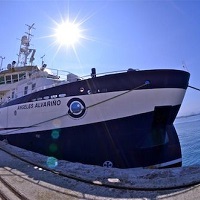
The EU funded MIDAS RTD project (7th FP, gran agreement 603418) overarching objective is to determine the impact of deep-sea mining on deep marine ecosystems. To investigate the behaviour and the effects of heavy metal rich resuspended sediment plumes over benthic organisms and ecosystems, the University of Barcelona coordinates a plume generation and monitoring experiment in the bay of Portman, SE of Spain, where millions of tones of metal rich mine tails from onshore mines were dumped from 1957 to 1990. Prior to the seafloor disturbance experiment to generate the plumes, a careful mapping of the study area, and in particular of the area covered by the mine tails deposit was carried out. Two vessels are used for the disturbance experiment. The first vessel generates the plumes by bottom trawling, while the second one monitors the plume evolution through time with a variety of sensors, including acoustics. Moorings with sediment traps, current-meters, mussel ropes and baited traps are deployed in and around the seafloor area disturbed by the trawler.
-
The main objectives for the MedSeA cruise are to: - Refine climatological maps of carbonate species distribution (pH, pCO2, CO32-, CT, AT, CaCO3 saturation states), along with their isotopic signatures, in the Mediterranean Sea. - Report on the determination of the anthropogenic carbon distribution throughout the whole Mediterranean Sea and its associated uncertainty estimate - Determine the effects of carbonate chemistry on Mediterranean calcifying and non-calcifying planktonic organisms. - Determine synergistic effects of acidification, warming and nutrients on key pelagic organisms. - Identify and quantify responses of fundamental Mediterranean biogeochemical processes to acidification and warming. - MedSeA is carried out in collaboration with the Geotraces program in order to collect water for chemical large volume trace elements and isotopes such as Th/Pa, Artificial radionuclides, Th-234, Nd-isotopes and Ra.